By
By 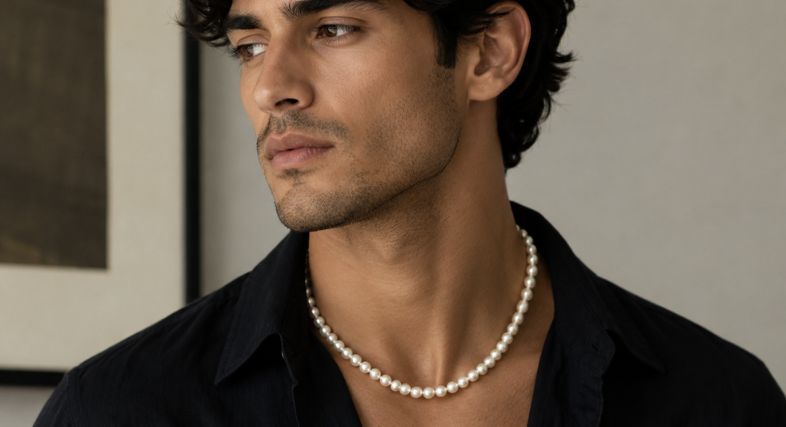
In 2019, a man in pearls still turned heads. When Harry Styles walked the Met Gala in a single drop pearl earring, plenty of people read it as a costume choice, a one-night statement that would fade with the after-party. It didn’t fade. Five years on, the pearl strand has shown up on rappers, athletes, runways, and the necks of regular guys buying their first piece online. So the question worth asking now isn’t whether men can wear pearls. It’s whether this is a moment that’s about to pass, or a shift that has already settled in.
The honest answer lives in the data, the history, and a few things about pearls themselves that most trend coverage skips over.
The Five-Year Arc: From Shock to Shrug
Look at the timeline, and a pattern shows up fast.
Styles wore that earring at the 2019 Met Gala, then made a full pearl necklace part of his regular look through 2020. The same year, Japanese pearl house Mikimoto partnered with Comme des Garçons on a men’s pearl line that added safety pins and spikes to a 50cm strand, and that collection is still in production. A$AP Rocky started layering pearls with streetwear. Pharrell Williams, Shawn Mendes, and Timothée Chalamet followed in their own ways. By 2021, baseball player Joc Pederson was wearing a pearl strand in the dugout, which is about as far from a fashion runway as jewelry gets.
That last detail matters more than the red carpet ones. Trends die when they stay locked to celebrities. They survive when they cross into places where nobody is being photographed for a magazine.
Here’s the tell: the early reaction was shock, and the current reaction is a shrug. A pearl necklace on a man in 2020 sparked online debates about masculinity. In 2025, it reads as a styling choice, no different from picking a silver chain over a gold one. When the controversy drains out of something, and the thing stays, that’s usually how you know a trend turned into a norm.
What the Market Data Actually Shows
Cultural moments are easy to overstate. Money is harder to fake.
Start with how men themselves see it. In a 2024 survey of just over 1,000 American men cited in Grand View Research’s jewelry market analysis, 78% said they believe men’s jewelry is becoming more mainstream. When roughly four out of five men in a category tell you the category is going mainstream, that’s not a fashion editor’s opinion. That’s the buyers themselves.
The spending backs it up. Polaris Market Research valued the U.S. men’s jewelry market at $5.64 billion in 2024 and projects it to grow at about 8.4% a year through 2034, faster than the jewelry market overall. Pearls keep getting named in these reports as one of the categories pulling that growth, tied directly to the rise of gender-neutral design.
A few forces are stacked behind the numbers:
- Direct-to-consumer brands made it easy to buy good men’s jewelry online without walking into a store built for someone else’s taste.
- Gen Z and younger millennials treat jewelry as self-expression rather than a gendered category, which widens the buyer pool considerably.
- Hip-hop and K-pop kept pearls visible in music culture, not just fashion week, which is where most men actually take their cues.
No single data point proves permanence. But a trend backed by sustained market growth, multiple buyer generations, and presence across several culture industries at once behaves very differently from a flash in the pan.
Pearls Were Always a Men’s Gem (We Just Forgot)
The framing of pearls as feminine is recent, and it’s worth knowing how recent.
For most of recorded history, pearls signaled wealth and power, and men wore them openly. Kings, maharajahs, and royal courtiers used pearls the way later generations used gold watches. The shift happened around the 18th century, in a move some historians call the Great Male Renunciation, when men’s dress pulled away from ornament toward plainer, more utilitarian clothing. Pearls drifted to the women’s side of the counter and stayed there for a couple of centuries.
So the current trend isn’t men borrowing something. It’s men reclaiming something that was theirs first. That distinction changes how you read it. A borrowed look tends to get returned. A reclaimed one tends to stick, because it’s filling a space that was artificially closed off rather than inventing a new one.
If you want a piece that nods to that lineage, the place to start is understanding the difference between the major pearl types, from those used in rings and bracelets to those found in necklaces, and what separates a fine pearl from a costume one, because the history only means something if the pearl on your neck is actually worth wearing.
How to Tell Quality, Because Most Men Don’t Know Yet
The trend gets its real test right here. A look survives when buyers get more sophisticated, not less. Here’s what separates a piece you’ll keep from one you’ll regret.
Pearls are soft. On the Mohs hardness scale, pearls rate between roughly 2.5 and 4.5, which makes them one of the softest things you can wear daily. For comparison, a diamond sits at 10. This isn’t a reason to avoid them. It’s a reason to know how to treat them. The Gemological Institute of America notes that pearls can be damaged by acids, perfume, hairspray, cosmetics, and even perspiration, which is why the old jeweler’s rule is “last on, first off.” Put your pearls on after the cologne, take them off before the shower.
Freshwater versus saltwater changes the piece. Most men’s pearl jewelry uses freshwater pearls, which are grown in lakes and rivers, often many at once inside a single mollusk. Saltwater pearls like Tahitian or Akoya are rarer. A single Tahitian pearl can take five to seven years to form inside one oyster, which is part of why they cost more and carry that natural dark, peacock-toned color rather than a dyed one. Neither is “better.” Freshwater gives you value and everyday wearability; Tahitian gives you a statement and natural color. Knowing which you’re buying is the whole game.
Baroque is your friend. The irregular, organic shapes called baroque pearls tend to suit men’s styling better than perfectly round strands. The imperfection reads as character instead of bridal-shop polish, and it layers naturally with chains and leather.
If a seller can’t tell you whether a pearl is freshwater or saltwater, dyed or natural, that’s your answer about the seller.
Styling It Without Looking Like You’re Trying
The men who wear pearls well share one habit: restraint. A$AP Rocky layers, but he’s A$AP Rocky. For everyone else, the move is usually one piece, worn with confidence, against a simple backdrop.
A single strand over a plain white tee or a black crew works because the contrast does the heavy lifting. A pearl necklace under an open collar with a blazer reads as quiet sophistication rather than costume. If you want to layer, pair one pearl strand with one metal chain and stop there. The mistake isn’t wearing pearls. It’s wearing five things at once and hoping one of them lands.
For a first piece, a shorter strand or a pearl-and-chain hybrid is the lowest-risk entry. It gives you the texture without committing to a full classic strand before you know how you feel wearing it.
So, Trend or Here to Stay?
Trends fade when they depend on a single famous person, stay locked to red carpets, and never develop an informed buyer base. Men’s pearls fail all three of those tests. The look has spread across generations, crossed from celebrity into everyday wear, picked up real market growth behind it, and reconnected with a history where men wore pearls for centuries before they stopped.
That’s not the profile of a fad. That’s the profile of a category that’s done settling in.
The smarter question for any man reading this isn’t whether pearls are still cool. It’s whether you’d actually wear one, and which kind suits the life you live. Answer that, learn enough to buy a real pearl instead of a dyed bead, and the trend question stops mattering. You’ll just have a piece you like.